

Artificial intelligence is no longer theoretical. It is embedded in logistics networks, agricultural systems, hospital workflows, legal offices, financial platforms, classrooms, and creative tools. The public conversation often asks whether AI will replace human work. That framing is already wrong.
The real question is narrower and more serious: what human work should remain — and what might actually make more sense for AI or automation to take on?
This is not about capability. AI systems can already classify medical images, draft legal documents, generate software code, optimize warehouse routes, and detect industrial anomalies. The question is not what machines can do. The question is what they should do, and under what conditions.
Work is not only a paycheck. It is identity, structure, belonging, and political agency. It is also practice. Through work, people sharpen judgment, develop skill, test ideas against reality, and build the competence needed to shape their own lives and communities. When AI takes on too much, especially in domains that cultivate reasoning and responsibility, humans may retain income while losing the very capacities that sustain democracy and self-governance.
So this is not a simple argument that AI should take dangerous jobs and leave everything else alone. That principle is part of the story. It is not the whole story.
We need a deeper framework.
Replace Preventable Harm First
There are domains where the ethical case for automation is strong. When work is defined primarily by exposure to preventable danger or long-term bodily damage, substituting technology for human risk is not dehumanizing. It is protective.
Mining and Heavy Industry

Mining remains one of the most hazardous industries globally. Cave-ins, equipment collisions, toxic dust exposure, and heat stress continue to cause injury and death. According to the U.S. Mine Safety and Health Administration, dozens of miners die each year in the United States alone, with thousands more injured (MSHA data portal: https://arlweb.msha.gov/OpenGovernmentData/DataSets/MinesProdQuarterly.zip).
Autonomous haul trucks and remote-operated drilling systems are already deployed in large-scale mining operations in Australia and Canada. Companies such as Rio Tinto have operated autonomous fleets that remove workers from blast zones and unstable ground conditions. A World Economic Forum report on digital transformation in mining documents measurable reductions in safety incidents when automation is paired with strong safety governance (https://www.weforum.org/reports/digital-transformation-initiative-mining-and-metals-industry/).
The ethical logic is straightforward: when a task is defined by proximity to collapse or explosion, technology should absorb that exposure.
But replacement must not mean abandonment. Workers displaced from the most dangerous tasks should move into maintenance, remote operations control, safety analytics, and systems oversight roles. Automation without funded transition pathways is not protection. It is extraction.
Warehousing and Repetitive Strain

Warehouse work often involves repetitive lifting, long walking routes, and time-pressured picking quotas. The U.S. Bureau of Labor Statistics reports high rates of musculoskeletal disorders in warehousing and transportation occupations (https://www.bls.gov/iif/).
Vision-guided robots and automated storage systems can handle heavy or awkward loads and reduce repetitive bending. When designed around ergonomic reduction rather than pure throughput acceleration, such systems can lower injury rates.
The line is this: AI should remove strain. It should not intensify it.
If automation is deployed primarily to increase speed and tighten quotas for remaining workers, the technology shifts burden rather than reducing harm. Safety metrics, not just productivity metrics, should determine success.
Agricultural Harvesting
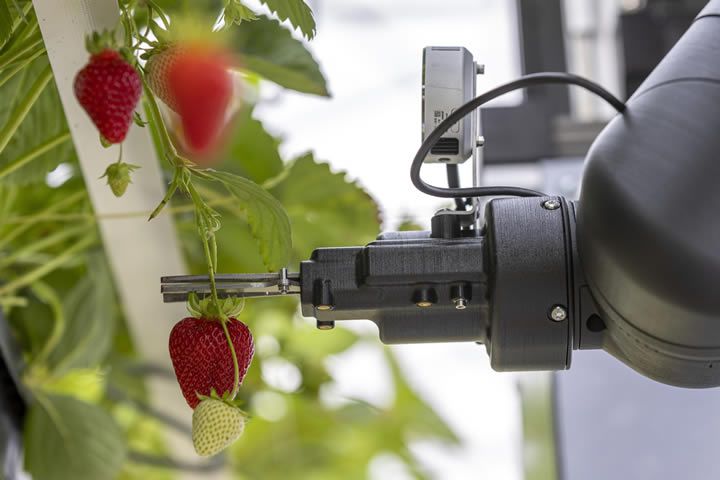
Field harvesting involves repetitive bending, ladder climbing, heat exposure, and seasonal instability. Agricultural robotics firms now deploy AI-powered harvesters capable of identifying ripe produce and picking with precision. The U.S. Department of Agriculture has documented the rise of precision agriculture technologies aimed at improving efficiency and reducing labor intensity (https://www.ers.usda.gov/topics/farm-practices-management/precision-agriculture/).
In principle, automation could take over the most body-breaking aspects of harvesting while humans supervise crop quality, manage systems, and coordinate logistics.
In practice, deployment often responds to labor shortages and cost pressure rather than worker health. The moral difference matters. Substituting AI for the most injurious tasks is protective. Eliminating workers without transition is destabilizing.
Continuous Safety Monitoring
AI systems excel at pattern recognition across multiple data streams. In industrial settings, computer vision and sensor-based monitoring can detect unsafe proximity, equipment malfunction patterns, and near-miss incidents in real time.
The National Institute for Occupational Safety and Health has explored the integration of advanced monitoring technologies to improve workplace safety outcomes (https://www.cdc.gov/niosh/topics/automation/default.html).
In these domains, AI enhances vigilance. It does not replace judgment. Human oversight remains essential, but cognitive overload is reduced.
Automate Tedium, Not Judgment
Beyond physical labor, automation increasingly targets cognitive routines.
Document triage, claims pre-processing, compliance screening, and basic code refactoring involve repetitive pattern recognition. AI systems can assist in these areas, generating drafts or flagging anomalies.
But the boundary must be clear: AI may assist decision-making. It must not silently assume it.
In safety-critical and rights-critical domains such as healthcare, criminal justice, welfare eligibility, and hiring, final authority must remain human and accountable. Research from the National Institute of Standards and Technology highlights ongoing challenges in AI explainability and bias (https://www.nist.gov/artificial-intelligence).
Delegating final decisions to opaque systems shifts power away from accountable individuals and toward infrastructure that cannot be voted out, challenged, or morally persuaded.
Automation should remove drudgery. It should not remove responsibility.
The Risk of Skill Atrophy
There is another risk that receives less attention: capability decay.
When AI systems draft emails, generate code, summarize documents, recommend diagnoses, and propose strategic decisions, humans may retain supervisory roles while losing fluency. Over time, skill becomes shallow. Judgment becomes outsourced. Confidence erodes.
Research on automation bias in aviation and medicine shows that humans tend to over-rely on automated systems, even when those systems are wrong (see Parasuraman & Riley, “Humans and Automation,” Human Factors, 1997; summary: https://journals.sagepub.com/doi/10.1518/001872097778543886).
If AI handles too much of the cognitive load, people may lose the friction that builds mastery. Friction is not always inefficiency. It is sometimes practice.
Democratic societies require citizens capable of reasoning, evaluating evidence, and exercising judgment. If core cognitive tasks are continuously offloaded, civic competence weakens.
Income without capability is a fragile stability.
Protecting Agency and Social Cohesion
To protect people in an AI-saturated economy means protecting more than wages.
Preserve Human Decision Rights
In healthcare, justice, hiring, and welfare systems, humans must remain accountable decision-makers. When AI recommendations are followed, documented reasoning should be required. Transparency creates contestability.
Invest in Lifelong Skill Development
The World Economic Forum’s Future of Jobs Report consistently emphasizes the need for reskilling in digital literacy, critical thinking, and AI collaboration (https://www.weforum.org/reports/the-future-of-jobs-report-2023/).
Workers should not compete against AI. They should be trained to supervise, interpret, and refine it. Skill-building must be continuous, not episodic.
Protect Human Interaction
Care work, teaching, counseling, and community services depend on relational presence. Studies on loneliness and social fragmentation underscore the health risks of weakened human contact (U.S. Surgeon General Advisory on Loneliness, 2023: https://www.hhs.gov/sites/default/files/surgeon-general-social-connection-advisory.pdf).
AI may assist with documentation or scheduling. It should not replace relational engagement at the core of care.
Information Hygiene
Generative AI increases the volume of synthetic media. The OECD has warned about the risks of AI-generated misinformation to democratic institutions (https://www.oecd.org/digital/ai/).
Watermarking systems, provenance standards, and media literacy are essential to preserve collective reasoning capacity.
Safety and Transition Without Universal Basic Income
If universal basic income is absent and formal protections are limited, skill and safety become the primary social floor.
Make Safety Non-Negotiable
Automation should be tied to measurable reductions in injury rates and hazardous exposure. Regulatory bodies or worker organizations must retain authority to halt systems that worsen conditions.
Build Transition Ladders
Each automation deployment should include funded retraining slots connected directly to affected workers. Roles such as robot technician, safety analyst, AI systems supervisor, and logistics coordinator should be structured pathways, not vague promises.
Share Productivity Gains
If AI enables greater output with fewer workers, gains should not accrue solely to capital owners. Shorter work weeks, wage floors, or profit-sharing models can distribute benefits more equitably.
The Economic Policy Institute has documented the decoupling of productivity growth from wage growth over recent decades (https://www.epi.org/productivity-pay-gap/). Automation should not deepen that divide.
Protect Local Economic Density
AI systems that centralize data and profit in a handful of platforms risk hollowing out local economies. Policies that support AI augmentation for small firms, farms, and community services can counteract excessive concentration.
The Energy Constraint
AI is not immaterial. Data centers consume significant electricity and water. The International Energy Agency estimates that data centers currently account for around 1 to 1.5 percent of global electricity demand, with rapid growth projected (IEA, Electricity 2024: https://www.iea.org/reports/electricity-2024).
If AI removes physical risk from a warehouse but increases fossil-fuel-powered compute demand elsewhere, risk shifts rather than disappears.
Responsible deployment requires:
- Energy-efficient model design.
- Alignment with low-carbon grids.
- Evaluation of total lifecycle emissions.
- Avoidance of trivial applications with high compute cost.
Technology that protects workers while destabilizing climate systems creates delayed harm.
What Should Remain Human
Work that cultivates moral judgment, empathy, creativity, and civic responsibility should remain human-led.
Teaching that shapes citizens. Nursing that comforts the vulnerable. Journalism that investigates power. Local governance that deliberates on shared futures. Artistic creation that interprets collective experience.
AI may assist these roles. It should not replace them.
The dividing line is not simply physical versus cognitive. It is developmental. Does the work build human capability? Does it sustain social trust? Does it require accountable judgment under uncertainty?
If so, it deserves to remain human-centered.
Designing Automation Around Dignity
The future of work is not predetermined. Automation is not inevitable. It is shaped by policy, labor power, corporate governance, and public expectation.
AI should absorb preventable harm and repetitive strain. It should assist with cognitive tedium. It should enhance safety monitoring and expand human analytical capacity.
It should not hollow out skill. It should not centralize unaccountable decision-making. It should not erode democratic competence. It should not expand planetary risk without constraint.
Work is not only a paycheck. It is identity, structure, belonging, and political agency. It is also rehearsal for self-governance.
If automation reduces injury, builds skill, distributes gains fairly, preserves agency, and respects ecological limits, it can improve humanity.
If it preserves wages while eroding capability and concentrating power, it undermines the very foundations it claims to optimize.
The boundary between those futures is not technological. It is ethical and political.
To continue exploring the critical intersections of technology, ethics, and our global future, we invite you to browse our other categories on Interconnected Earth including: Wealth and Labor, Mental Health, Technology, Philosophy, and World.
One thought on “What Human Work Should Remain — and What Might Make More Sense for AI or Automation To Actually Take On?”
Comments are closed.