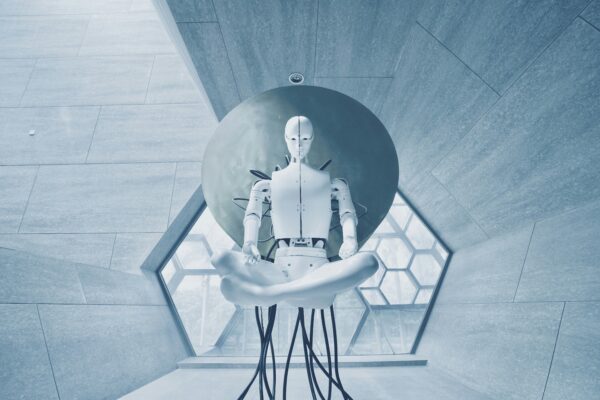
White Sci-Fi robot with a cables coming out of it sitting meditating

How Sci-Fi Becomes Reality: When Speculation Turns Into Systems, Products, and Power

Science fiction is often treated as entertainment, escapism, or metaphor. In practice, it functions as an informal research and development lab for civilization. Writers imagine futures, audiences absorb them, engineers and policymakers internalize them, and corporations eventually build them. What begins as speculative narrative becomes technical roadmap, corporate product strategy, and state policy architecture. This…

Read More
Freedom shown by a person standing in the sunrise with their arms stretched wide

What Is Freedom? A Philosophical Exploration of Choice, Constraint, and Responsibility

Few questions are as old, persistent, and contested as the question of freedom. Humans have asked it across cultures, religions, political systems, and philosophical traditions. What does it mean to be free? Is freedom something granted by society, something inherent to human nature, or something that exists only in theory? Depending on who you ask,…

Read More
China's Flag symbolizing China's rise

Centralization vs. Interdependence: How China’s Rise Reveals the Tensions of a Connected World

Here we examine how China’s push for technological self reliance, its global infrastructure ambitions through the Belt and Road Initiative, its economic trajectory, and Xi Jinping’s consolidation of political power illustrate a deeper systemic pattern. Interconnected systems create power, but power often seeks to reduce dependence on those systems.

Read More
a slice of cheesecake set to represent the slice of the pie labor makes up

Labor and Wealth in a Slice of Cheesecake: Capital and Extraction in the Modern Economy

Here we examine worker pay, executive compensation, shareholders, and profit margins through a specific example: Philadelphia Cream Cheese, owned by Kraft Heinz. We use this case to explore the widening wealth divide, the structural difference between ancient reciprocal economies and modern financialized supply chains, and what it would realistically take to make the system more equitable without collapsing productivity or retirement systems.

Read More
Autonomous vehicles -Self-driving car in urban environment

Autonomous Vehicles and the Cost of Convenience: Innovation at a Crossroads

Autonomous vehicles were once framed as an inevitability — a clean technological arc that would move transportation forward in the same way seatbelts, airbags, and GPS once did. For years, the public conversation leaned heavily toward promises: fewer crashes, cheaper transportation, reduced congestion, and newfound freedom for people unable or unwilling to drive. The assumption…

Read More
Person sitting on a leather couch, head in hand with compassion fatigue

Moral Fatigue in the Age of Advanced Information: Understanding, Surviving, and Responding

Since 2020, the world has experienced an unprecedented cascade of historic events—pandemic, political upheavals, wars, climate disasters, social movements, economic shifts, and rapid technological transformation. These collective experiences have not only shaped global history, they have also exerted extraordinary psychological and emotional pressure on individuals around the world. As news cycles compress and digital platforms flood us with information, many people find themselves exhausted not just physically, but morally and emotionally. This state—commonly described as moral fatigue or compassion fatigue—is increasingly recognized as a widespread response to continuous exposure to global crises.

Read More
Library with books and sculptures.

Philosophy in Motion: How Ideas and History Shape Each Other

Philosophy is often imagined as something distant and abstract—an academic exercise confined to old books, lecture halls, or debates that feel removed from everyday life. For many people, it conjures images of ancient thinkers arguing over obscure questions, disconnected from the urgent realities of work, politics, survival, and change. But this perception misses the true nature of philosophy entirely.

Read More
A clear glass jar filled with coins topped by a small growing plant, symbolizing wealth accumulation and growth.

Why the Wealthy Must Be Mentally Healthier — and Why It Matters to Us All

Mental illness is not limited to poverty. People experiencing financial insecurity face intense, chronic stress from unmet survival and safety needs — and that has predictable, damaging effects on mental health. But abundance isn’t a cure: the wealthy can be mentally unwell in ways that are less visible but no less consequential.

Read More
A person wearing a full hazmat suit and yellow gloves stands in a dimly lit forest at night, spraying disinfectant onto a glowing, miniature Earth resting on the ground. The surreal scene highlights themes of human intervention, environmental control, bio-engineering, climate anxiety, and the belief that technology can “fix” the planet.

The Case Against Living Forever

The idea of living forever is one of humanity’s oldest obsessions. From mythology to medicine to Silicon Valley futurism, the possibility of extending life indefinitely appeals to our fear of death and our desire to witness the future. But when we examine immortality beyond the fantasy and look at the ecological, economic, psychological, and ethical consequences, the dream becomes far more complicated.

Read More