

There is a quiet crisis cascading through our global social fabric. It does not always manifest in sudden public strikes or dramatic societal collapse, but rather in the quiet, cumulative weight carried by millions of individuals waking up every morning. Across digital networks, office buildings, remote workspaces, and production lines, an overwhelming feeling of labor fatigue has reached a critical threshold.
At Interconnected Earth, we examine human society not as a collection of isolated economic units, but as an integrated ecological system. Just as an ecosystem collapses when its natural resources are extracted faster than they can regenerate, human biological and psychological systems fray when demands permanently exceed capacity. When we look closely at collective behavioral indicators, specifically two search engine trends in this blog, public health surveys, and labor analytics, the signal is undeniable: humanity is at an unprecedented breaking point with modern work culture.
Part I: The Anatomy of a Search Query: “I Don’t Want to Work Anymore”
Search engine data functions as a digital confession box. In public, individuals maintain professional facades, adhere to corporate decorum, and project resilience. In private, behind glowing browser screens, people type their rawest truths into Google.
When we analyze search interest in the United States over the past twenty years, one query stands out for its emotional clarity: “I don’t want to work anymore.”
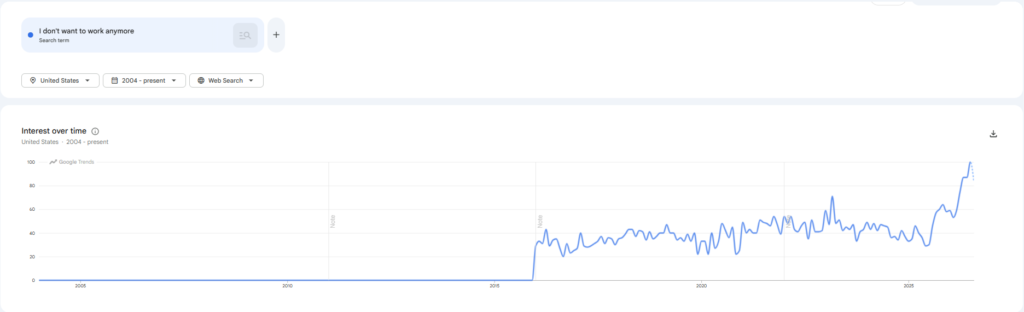
From 2004 through mid-2016 (long before Kim Kardashian exclaimed that people didn’t want to work anymore on March 9, 2022), public search interest for this phrase hovered at a flat baseline near zero. The societal contract, the unspoken agreement that long hours, continuous productivity, and delayed gratification would yield economic security and personal fulfillment, remained largely unchallenged in the public consciousness.
However, beginning in late 2015 and 2016, subtle upward shifts began to emerge, reflecting growing anxieties around stagnant wages, rising costs of living, and hyper-connected digital workplaces. The post-2020 landscape further ruptured traditional expectations. By late 2025 and mid-2026, search interest exploded, reaching an absolute historical maximum of 100 on Google Trends’ index.
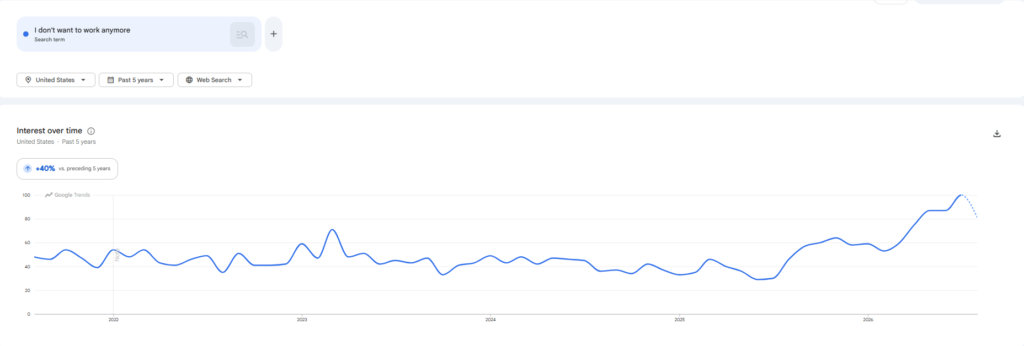
Narrowing the scope to a five-year period illustrates the sheer velocity of this shift. Search volume for “I don’t want to work anymore” surged by +40% compared to the preceding five years. The curve demonstrates a dramatic, sustained escalation through late 2025 and 2026, proving that this sentiment is not a temporary seasonal slump or a brief holiday reaction. It represents a fundamental, structural exhaustion across the workforce.
The Drivers of Modern Labor Detachment
To understand why millions of people are simultaneously reaching for this search phrase, we must examine the structural pressures bearing down on everyday life:
- The Erosion of Purchasing Power: According to data from the American Psychological Association (APA), 54% of U.S. workers cite job insecurity and economic pressures as primary drivers of daily stress. When wages fail to keep pace with housing, healthcare, education, and basic necessities, the implicit reward mechanism of labor breaks down. Work is no longer perceived as a path toward thriving, but as a grueling treadmill required merely to keep pace with inflation.
- The “Always-On” Digital Tether: The widespread adoption of remote and hybrid work environments, while offering flexibility, has shattered physical boundaries between labor and home life. The Mind Share Partners 2025 Workplace Mental Health Study revealed that only 49% of workers feel comfortable fully disconnecting after hours or during time off. Furthermore, Gallup research indicates that 72% of remote and hybrid employees experience burnout, largely driven by blurred work-life boundaries and continuous digital availability.
- Chronic Understaffing and “Doing More with Less”: A recurring theme across healthcare, education, technology, and customer support is structural understaffing. In Moodle’s global workforce surveys, nearly 20% of employees reported taking on unsustainable workloads due to industry-wide labor shortages. Employees are routinely expected to perform the tasks of two or three positions without corresponding increases in compensation or time.
Part II: The Burnout Crisis: Deciphering Data Anomalies and Modern Peaks
Alongside queries expressing a desire to leave the workforce, searches for the term “burnout” have reached extraordinary levels. According to recent data from Management.org and eMonitor, approximately 66% to 67% of all U.S. employees report experiencing burnout symptoms in their current roles, a steep rise from 52% recorded just a few years prior.
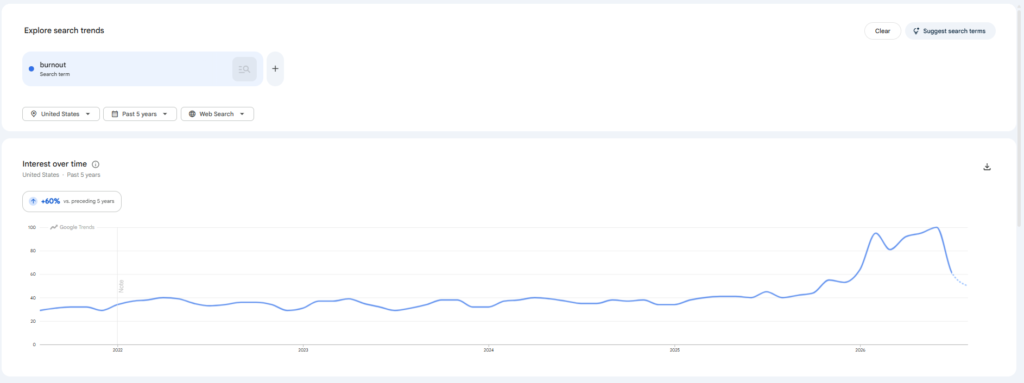
Over the past five years, search volume for “burnout” jumped by +60%, accelerating heavily through late 2025 and 2026. The American Psychological Association notes that 44% of workers now feel burned out “often” or “always,” transforming what was once considered an acute, temporary state into a chronic occupational condition.
However, when examining long-term search data dating back to 2004, an intriguing historical pattern appears, one that requires contextual analysis to fully understand.
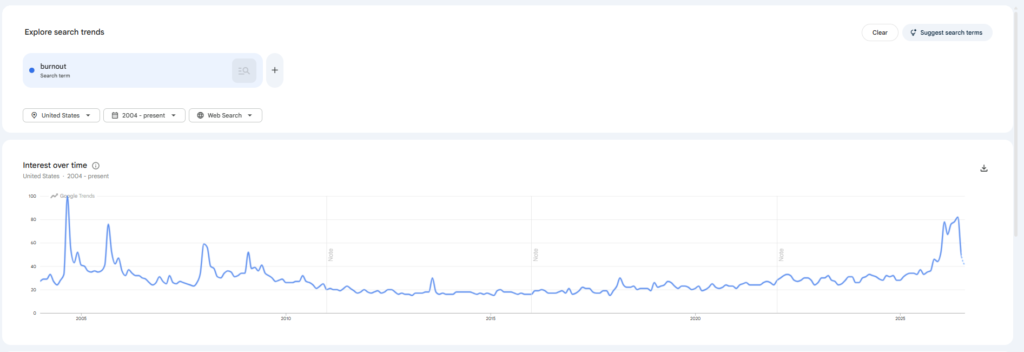
The Video Game Anomaly: Why 2004–2008 Looked “Burned Out”
At first glance, a casual observer looking at the 2004–present graph might assume that societal burnout peaked two decades ago and only recently returned to those historical heights. However, this interpretation misses a crucial cultural detail: the historical spikes in 2004, 2005, and 2008 were not driven by overworked employees, but by popular video games.
During the mid-2000s, Criterion Games and Electronic Arts (EA) released several highly anticipated installments of the critically acclaimed arcade racing video game franchise Burnout:
- Late 2004 (Historical Peak = 100): The launch of Burnout 3: Takedown, widely considered one of the greatest racing video games of all time, created a massive wave of search traffic surrounding game reviews, cheat codes, and walkthroughs.
- Late 2005 Spike: The simultaneous excitement and commercial releases for Burnout Revenge (console) and Burnout Legends (handheld devices) generated another dramatic surge in search queries.
- Early 2008 Spike: The release of Burnout Paradise, an open-world entry in the series, caused a third distinct spike in search interest.
During those years, search engines were primarily indexing gamers looking for video game media rather than workers researching occupational health, emotional exhaustion, or workplace fatigue.
Once the gaming franchise went dormant after 2010, search interest for “burnout” dropped to a quiet, flat baseline for over a decade. The dramatic rise seen between late 2025 and mid-2026 represents the first time that clinical and occupational burnout searches have climbed to rival those historic entertainment peaks. What was once a high-octane gaming term has now become a defining metric of human exhaustion.
Part III: Demographics, Sectors, and the Cost of Human Depletion
The current burnout landscape is not distributed evenly across society. Specific sectors, age cohorts, and demographic groups bear a disproportionate share of systemic strain.
1. Generational Disparities: Younger Workers on the Frontlines
Data from Deloitte and Moodle highlights a stark generational divide. Gen Z (aged 14 to 29) and Millennials (aged 30–45) report the highest rates of workplace burnout, with 71% to 83% experiencing significant job-related stress and fatigue.
For younger generations entering the labor market, several factors converge:
- Unpaid Overtime and Financial Strain: Research indicates that 48% of young workers regularly work unpaid overtime, while 46% take on extra working hours simply to offset the rising cost of living.
- Housing and Stability Barriers: Unlike previous generations who viewed hard work as a direct pathway to property ownership and economic stability, younger workers face home-to-income ratios that make traditional milestones feel unattainable.
- Isolation and Disconnection: Over 44% of younger employees report feeling isolated, particularly in poorly managed remote or hybrid settings that lack mentorship and authentic human connection.
2. Industry-Specific Breakdown
Occupational health data from 2025 and 2026 demonstrates that high-contact, high-intensity fields are experiencing severe operational drag:
| Industry Sector | Reported Burnout Rate | Primary Systemic Drivers |
| Healthcare | 76% – 82% | 12-hour shifts, post-pandemic staffing deficits, administrative overhead, exposure to trauma. |
| Education (K-12 & Higher Ed) | 73% – 78% | Expanding class sizes, behavioral management issues, stagnant real wages relative to inflation. |
| Business Process Outsourcing (BPO) | 74% | Monotonous routines, constant performance monitoring, high emotional labor, 11-month average tenure. |
| Technology & Engineering | 71% – 74% | “Crunch culture,” on-call incident responses, rapid sprint timelines, fears around AI replacement. |
| Financial Services | 68% – 80% | Extreme weekly hours (60–80 hours in investment banking), strict regulatory burdens, market volatility. |
| Retail & Hospitality | 65% | Irregular shift scheduling, low wages, physical exertion, customer-facing emotional labor. |
(Sources: National Academy of Medicine, Haystack Analytics, American Bar Association, Gallup)
3. The Middle Manager Pressure Cooker
Mid-level managers experience some of the highest burnout levels across all corporate roles, sitting at 78% according to Gallup workplace reports. Positioned between senior executive demands for productivity and front-line staff struggling with exhaustion, managers are expected to maintain team morale and output without receiving additional institutional resources or authority.
Part IV: The Ecological Perspective: Work Culture as an Extractive System
The modern workplace model was largely designed during the Industrial Era, a period built on the assumption that resources (both natural and human) are infinite and can be continually extracted without consequence.
When an agricultural ecosystem is farmed continuously without resting the soil, applying organic nutrients, or allowing natural regeneration, the soil eventually suffers from nutrient depletion and erosion. It becomes barren, susceptible to disease, and incapable of yielding crops.
Human beings operate under identical biological and ecological constraints:
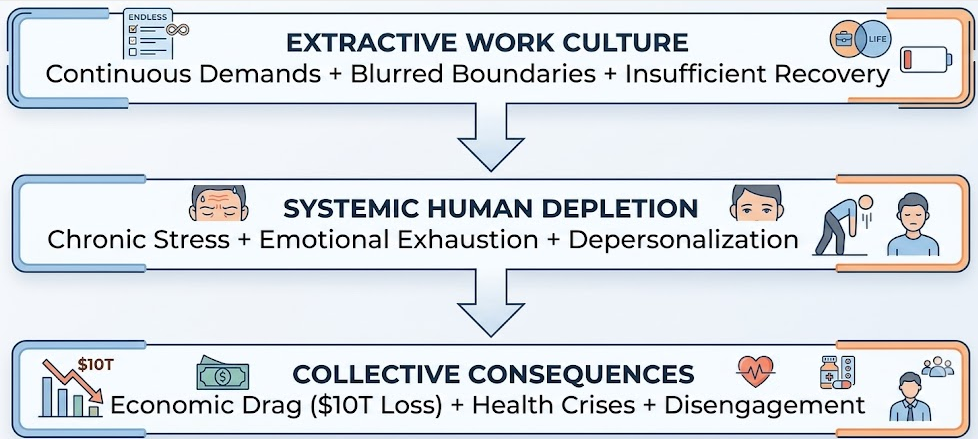
The Economic Footprint of Human Exhaustion
Treating human energy as an infinite resource carries immense global costs. The economic consequences of worker disengagement and burnout are staggering:
- $10 Trillion Global Productivity Loss: Gallup’s State of the Global Workplace 2026 Report estimates that falling employee engagement and workplace distress cost the global economy approximately $10 trillion in lost productivity, representing nearly 9% of global GDP.
- Turnover and Recruitment Costs: Research published by Workhuman and Management.org shows that low employee well-being creates an estimated $20 million in direct opportunity loss per 10,000 workers. Replacing a specialized employee lost to burnout typically costs between 1.5 to 2 times their annual salary when accounting for recruiting, onboarding, and lost operational momentum.
- Healthcare Expenditures: Chronic stress and occupational burnout are directly linked to cardiovascular disease, clinical depression, insomnia, and compromised immune function. The World Health Organization (WHO) formally classified burnout in its International Classification of Diseases (ICD-11) as an occupational phenomenon characterized by energy depletion, mental distance from one’s job, and reduced professional efficacy.
Part V: Moving Toward Regenerative Labor and Systemic Balance
If the data proves that traditional structures are depleting human capacity, what does a sustainable alternative look like? How do we build systems that respect human ecology while maintaining societal functionality?
1. Establishing Uncompromising Boundaries
The American Psychological Association reports that 95% of workers consider it essential for an organization to respect boundaries between work and non-work time. Policies such as the “Right to Disconnect”, which legally protects employees from responding to communications outside paid hours, are moving from progressive experiments into necessary baseline standards across several global jurisdictions.
2. Rethinking Work Structure and Duration
Extensive global trials of four-day workweek models (32 hours for 100% pay with 100% output) have consistently yielded remarkable results:
- Burnout Reduction: Participating companies report a 71% reduction in employee burnout symptoms.
- Retention Improvements: Staff turnover dropped by an average of 57% during trials, while overall physical and mental well-being metrics improved significantly.
- Sustained Output: Organizations maintained or increased overall revenue and output by eliminating redundant meetings, streamlining workflows, and allowing workers time to rest.
3. Cultivating Meaningful and Autonomy-Driven Labor
Gallup’s global research highlights that employee well-being increases dramatically when individuals perceive their work as intrinsically rewarding and beneficial to others. Furthermore, when employees feel they have genuine choice and autonomy in how they execute their responsibilities, they are nearly 50% more optimistic about their future and far less prone to emotional exhaustion.
Conversely, when work is stripped of autonomy and reduced to micromanaged metrics, detachment becomes a natural human defense mechanism.
The Road Ahead
The Google Trends curves for “I don’t want to work anymore” and “burnout” are not random anomalies. They represent a collective cultural signal, a warning light on the dashboard of our modern economic system.
When millions of individuals independently search for an escape from daily labor, they are not expressing laziness; they are expressing exhaustion. They are pointing out that human beings are living organisms with fundamental physical, emotional, and psychological boundaries.
To build a resilient future, business leaders, policymakers, and communities must recognize that human energy, much like the natural systems of our planet, requires active protection, rest, and regeneration. Until our institutions align with these basic ecological realities, the quiet refusal of the global workforce will only continue to grow.
Sources & References
Gallup: State of the Global Workplace Report
American Psychological Association (APA): Work in America™ Survey Reports
Mind Share Partners: Workplace Mental Health at Work Report
U.S. Department of Health and Human Services (HHS): Surgeon General’s Framework for Workplace Mental Health & Well-Being
World Health Organization (WHO): ICD-11 Official Definition of Occupational Burnout
Deloitte: Global Gen Z and Millennial Survey
Google Trends Data: Search Interest Analysis (2004–2026): Public search query indexes for “I don’t want to work anymore” and “burnout”.