
There is a common instinct to treat life as fragmented. Work is separate from mental health. Technology is separate from nature. Personal struggles are isolated from global events. Wealth is disconnected from labor. History is something that happened “back then,” rather than something still unfolding through us.
We started Interconnected Earth to challenge that instinct.
Not as a metaphor, but as a working framework for understanding reality itself.
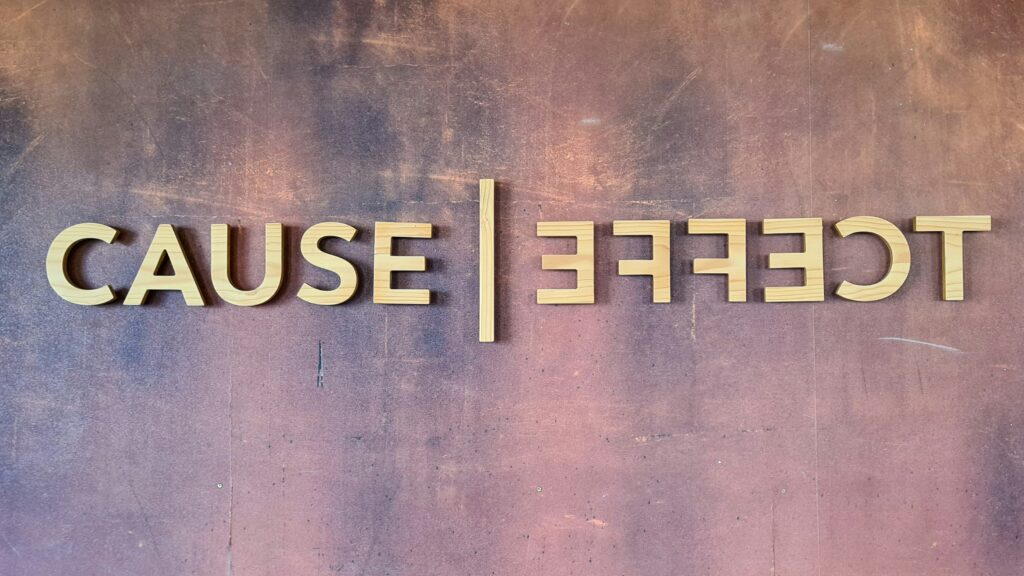
Because to the best of our current knowledge, nothing exists in isolation. Everything is part of a system of cause and effect. Every outcome has conditions. Every condition has origins. Every origin has a history. And that history is not abstract. It includes you.
This is not just philosophical. It is biological, economic, technological, and deeply personal.
Here we explore what it means to live in a world where everything is interconnected, where randomness is often a placeholder for incomplete understanding, and where even the smallest individual life is inseparable from the broader story of humanity.
The Universe as Cause and Effect
At the most fundamental level, the universe operates through causality.
Physics describes systems that evolve based on prior states. Biology builds complexity through accumulated adaptations. Even chaotic systems, which appear random, are governed by underlying rules that we do not fully understand.
The idea that “nothing is random” does not mean everything is predictable. It means that what we call randomness is often a reflection of limited information or computational limits.
For example, chaos theory shows how small initial conditions can lead to vastly different outcomes, even when systems follow deterministic rules. The classic “butterfly effect” illustrates that what appears unpredictable is often the result of sensitivity to variables we cannot fully measure.
You can explore this concept further through research from the Santa Fe Institute on complexity science:
https://www.santafe.edu/research/topics/complexity
What this suggests is not that life is controlled, but that it is connected. Every moment emerges from prior conditions, even if we cannot map them perfectly.
Your Life Makes Sense, Even When It Doesn’t Feel Like It
If everything operates through cause and effect, then your current state, including your mental health, is not random either.
Stress, burnout, anxiety, and depression do not appear out of nowhere. They are responses to environments, histories, and biological predispositions.
The American Psychological Association has consistently highlighted how external conditions such as economic instability, work demands, and social isolation contribute to mental health outcomes:
https://www.apa.org/news/press/releases/stress
When viewed through an interconnected lens, mental health becomes less about personal failure and more about system interaction.
If you are overwhelmed, there are likely reasons:
- Economic pressures
- Social disconnection
- Work structure and expectations
- Information overload
- Biological predispositions shaped over generations
This does not remove agency. But it reframes responsibility. You are not an isolated unit malfunctioning. You are part of a system responding to inputs.
Understanding that changes how we approach both self-awareness and solutions.
Genetics as Memory, Not Destiny
Your body is not just yours. It is an accumulation.
Genetics encodes biological information passed down across generations. But beyond DNA sequences, emerging research in epigenetics shows that experiences, especially stress and trauma, can influence how genes are expressed.
Studies published by institutions like the National Institutes of Health suggest that environmental factors can leave biological markers that affect future generations:
https://www.ncbi.nlm.nih.gov/pmc/articles/PMC5977074/
This means that what your ancestors experienced can shape how your body responds to the world today.
Not in a mystical sense, but in a measurable, biological one.
- Stress responses can be heightened or dampened
- Metabolic tendencies can shift
- Behavioral predispositions can emerge
You are not just living your own life. You are carrying forward patterns, adaptations, and responses that were shaped long before you were born.
Again, this does not eliminate choice. But it expands the context in which choice exists.

History Is Not Behind You
Every world event that has ever happened feeds into the present.
Economic systems, political structures, cultural norms, and technological infrastructures are all products of prior decisions and conflicts.
Global inequality did not appear spontaneously. It is tied to colonial histories, industrial development, resource distribution, and policy decisions over centuries.
The World Inequality Database provides extensive data showing how wealth distribution has evolved over time and how historical systems continue to shape current disparities:
https://wid.world/
When you look at your own position in society, your opportunities, constraints, and even expectations are linked to these broader historical processes.
Your ancestors participated in these systems, whether as beneficiaries, victims, or something in between. And now you are part of their continuation.
History is not something you read. It is something you are inside of.
Technology as a Continuation of the Same Story
Technology often feels like a break from the past. But it is more accurate to see it as an extension of it.
Every technological system builds on prior knowledge, labor, and infrastructure.
The smartphone in your hand represents:
- Decades of semiconductor research
- Global supply chains
- Labor from multiple continents
- Energy systems that power production and networks
- Economic incentives that drive innovation
MIT’s research into technological systems highlights how innovation is rarely isolated. It emerges from networks of knowledge, capital, and labor:
https://economics.mit.edu/research
Technology does not exist outside the human story. It intensifies it.
It amplifies communication, accelerates production, and reshapes labor. But it also concentrates power, redistributes wealth, and creates new forms of dependency.
It is not separate from society. It is a reflection of it.

Labor, Wealth, and Power Are Deeply Interconnected
One of the clearest examples of interconnected systems is the relationship between labor and wealth.
Wealth does not appear in isolation. It is generated through systems of production, which depend on labor, resources, and organization.
Yet the distribution of that wealth is not equal.
Data from organizations like the OECD shows persistent disparities in income and wealth across and within countries:
https://www.oecd.org/inequality/
These disparities are not random. They are shaped by:
- Policy decisions
- Ownership structures
- Access to education and capital
- Historical advantages or disadvantages
Power structures emerge from these dynamics. Those who control resources and systems tend to influence outcomes in their favor.
But even these structures are not static. They evolve based on pressure, resistance, and changing conditions.
Labor movements, technological shifts, and cultural changes all play a role in reshaping how value is distributed.
And again, you are part of this system.
Whether through your work, your consumption, your voting, or your participation in society, you contribute to how these systems function.
You Are a Small Part of the Story, But Still a Part
It is easy to feel insignificant in the face of global systems.
Billions of people. Centuries of history. Complex networks that no single individual can fully understand or control.
And that is true. You are a small part of a very large system.
But small does not mean irrelevant.
In complex systems, small components can have meaningful effects, especially when aggregated.
Your actions influence:
- The people around you
- The systems you participate in
- The signals you send through markets and culture
Individually, these effects may seem minor. Collectively, they shape outcomes.
This is how social change happens. Not through isolated individuals acting alone, but through interconnected actions that build momentum over time.
You Have Limited Control, But It Is Real
One of the most important implications of an interconnected world is that control is both constrained and meaningful.
You do not control:
- The conditions you were born into
- The full structure of the global economy
- The entirety of technological systems
But you do have influence within your scope.
You can:
- Make decisions about how you respond to your environment
- Contribute to or resist certain systems
- Influence others through relationships and communication
- Develop awareness that changes how you navigate the world
This is not absolute control. It is partial agency.
And partial agency is enough to matter.
Why This Perspective Matters
Understanding interconnectedness is not just an intellectual exercise.
It changes how we interpret:
- Personal struggles
- Social systems
- Economic inequality
- Technological change
It can reduce misplaced blame, both toward ourselves and others, by highlighting the systems at play.
It can also increase responsibility, by showing that our actions are part of those systems.
Most importantly, it creates a more accurate map of reality.
A world where everything is disconnected is easier to simplify, but harder to understand.
A world where everything is interconnected is more complex, but also more honest.

Why We Started This
We started Interconnected Earth to explore these connections.
To examine how mental health links to economic systems.
How technology shapes and is shaped by power.
How history continues to influence the present.
How individual lives fit into global patterns.
Not to provide simple answers, but to build a clearer picture of how things actually work.
Because once you see the connections, it becomes harder to ignore them.
And once you understand that you are part of the system, it becomes harder to believe that you do not matter.
You Matter, Even If the System Is Larger Than You
In an interconnected world, value is not determined solely by scale.
You do not need to control the system to be part of it.
You already are.
Your experiences make sense within a broader context.
Your actions contribute to ongoing processes.
Your presence affects other people, directly and indirectly.
You are not outside the story. You are inside it.
For better or for worse, and in most cases both.
And that means something.
Even if it is only a small fraction.
Sources
American Psychological Association – Stress in America
https://www.apa.org/news/press/releases/stress
National Institutes of Health – Epigenetics and Inheritance
https://www.ncbi.nlm.nih.gov/pmc/articles/PMC5977074/
Santa Fe Institute – Complexity Science Research
https://www.santafe.edu/research/topics/complexity
World Inequality Database
https://wid.world/
OECD – Income Inequality Data
https://www.oecd.org/inequality/
MIT Economics Research on Technology and Systems
https://economics.mit.edu/research
Explore more from Interconnected Earth:
World Events: https://interconnectedearth.com/category/world-events/
Mental Health: https://interconnectedearth.com/category/mental-health/
Technology: https://interconnectedearth.com/category/technology/
Philosophy: https://interconnectedearth.com/category/philosophy/
Climate Change: https://interconnectedearth.com/category/climate-change/